Every track coach knows the tape measure routine.
Two people move in after every jump - one in the sand, the other crouched down, eyeballing the mark and reading off a number. Often it’s a third person that scribbles it on a clipboard. If you are paying a pro, you hand off the sheet of chicken scratch for them to decipher after the meet. Rarely do jumps ever make it to the live results page even when you hire a professional timer.
Running events are solved. Timing is solved. An affordable way to do live field event measurement has always been the gap.
That’s why we built JumpRail.
How Laser Long Jump Measurement Works
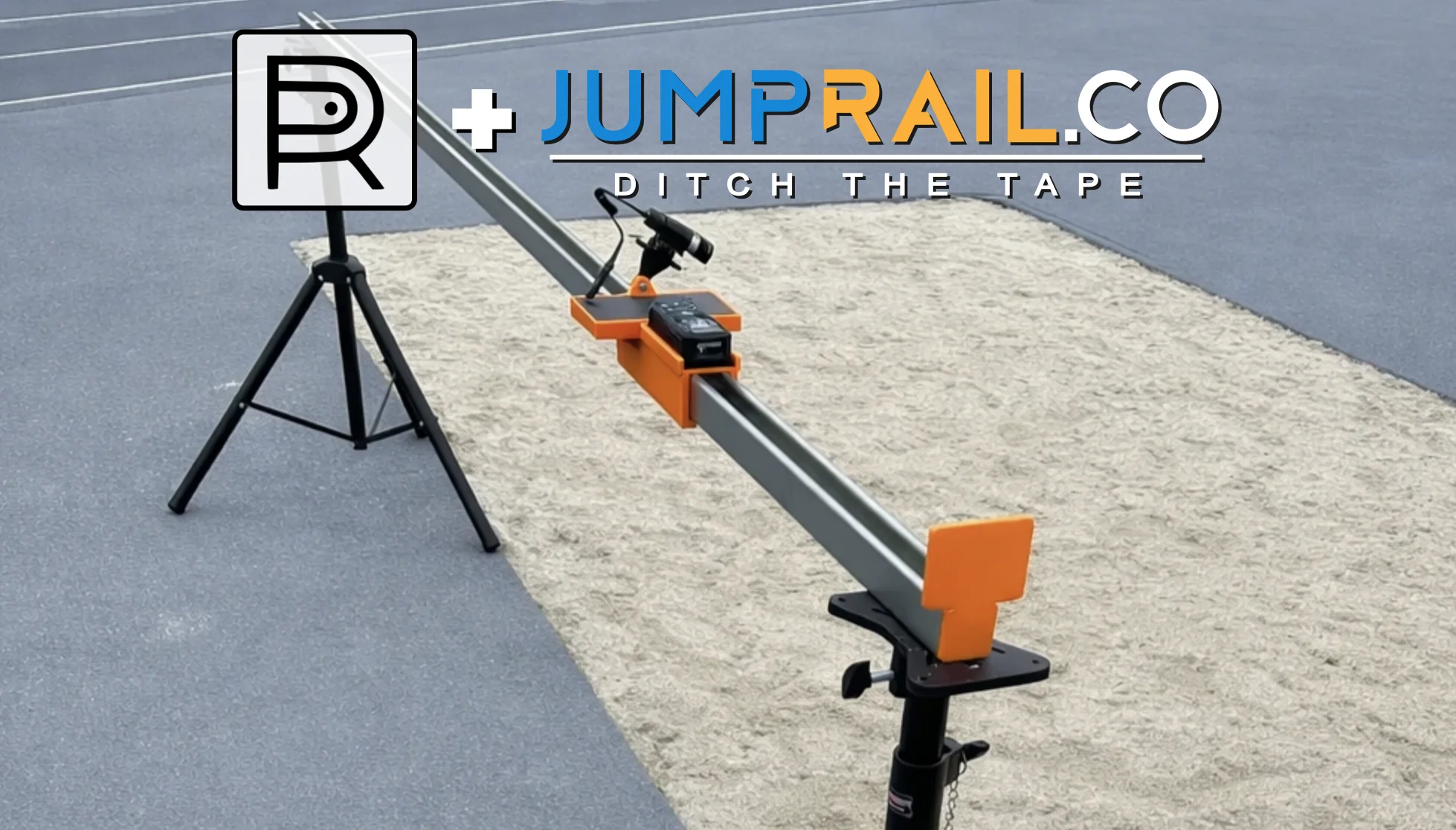
JumpRail is a laser measurement system for long jump and triple jump. A custom sled rides a standard unistrut rail beside the pit, carrying a Bosch Bluetooth laser range finder. Slide the sled until the green laser hits the landing mark in the sand. Tap Measure in the free iOS app. Done.
Each measurement is accurate to within 1/16 of an inch — the same precision as professional systems that cost 6–10x more.
One person handles all the measuring. You’ll still need someone raking the pit, but you no longer need a second person holding the other end of a tape.
What the Complete Kit Costs
The JumpRail kit is $299 at jumprail.co. You supply three things yourself:
- A 10-foot Unistrut rail (~$26 at Home Depot)
- A Bosch GLM165-27CG laser range finder (~$119, frequently on sale for $89)
- Two PA speaker tripods (~$41 for a pair on Amazon)
Total system cost: under $500.
| JumpRail | Professional laser systems | |
|---|---|---|
| Cost | ~$485 | $3,300–$5,800 |
| Accuracy | 1/16 inch | 1/16 inch |
| Operators needed | 1 | 1 |
Same accuracy. Built around a $90 Bluetooth range finder and 3D-printed hardware instead of a $4,000 chassis.
Live Field Event Results — Standalone or with RaceApp
JumpRail works as a standalone measurement app with built-in flight sheets. It exports to HyTek Meet Manager and CSV, so it fits into whatever system you’re already using.
But if you’re running your meet on RaceApp, you get live field event results on the same page as your running events. The two systems connect in about 30 seconds:
- Generate a guest admin QR code from your meet in RaceApp
- Scan it in the JumpRail app’s Settings tab
- JumpRail pulls in your field events automatically
- Pick your event and flight, add athletes by bib number (JumpRail looks up names and teams from RaceApp), and start measuring
Every measurement syncs to the live results page the moment it’s recorded. Scratches too. Athletes, coaches, and parents see field event results updating in real time — the same way they already see running event results.
Triple Jump, Multiple Boards, and Digital Flight Sheets
Multiple take-off boards — Calibrate multiple boards at the same time. Each board shows up as its own button in the app. When an athlete jumps, tap the board they used. One operator, one rail, all boards — no re-calibrating between attempts. This is where JumpRail gets especially useful for triple jump.
Digital flight sheets — Add athletes by bib number or manually by name. Manage attempts, record scratches, see standings update after each round. No clipboards.
13 sled colors — The measurement sled is 3D-printed to order in your choice of 13 colors. Small thing, but coaches love it.
Built by a Coach, for Coaches
I built JumpRail because I was running meets and quietly accepting that field event results just lagged behind everything else. I’d already built RaceApp for timing — long jump and triple jump were still clipboard-and-tape territory, and nobody was offering an affordable laser system to fix it.
So I designed one around a $90 Bluetooth laser and a unistrut rail. Same accuracy, a tenth of the price.
JumpRail requires a free companion iOS app and a Bosch GLM-series Bluetooth laser range finder (not included). RaceApp live sync requires any paid RaceApp plan. Full setup guide →